Thursday, May 8, 2014


Paving The Way to Change for Adolescent Substance Abuse

Recent media reports of young people dying from overdoses calls attention to the devastating effects of addiction – which has reached epidemic proportions. After years of decline, the current increasing incidence and prevalence of substance use among American adolescents is distressing as youth are five times more likely to develop a substance use disorder compared to adults. And unfortunately, this disease can (and frequently does) follow them for life: only about 10 percent of substance dependence cases occur after adolescence.

Thus, successful efforts to prevent, delay or minimize substance use during adolescence are sorely needed. They are the most economical and enduring way to reduce the many public health, safety, and economical threats associated with addiction. And yet, as a country, we pay little attention to prevention, early intervention, effective treatment or continuing care for this age group. We pay little attention to these issues for our kids. The imperative to do better is clear, and the pathway to change has never been more possible.

As a result of significant legislative and scientific advances, and a growing public understanding about addiction and its devastating effects, the substance abuse field is poised for positive transformation. The necessary elements for change are now in place, and with proper alignment and leveraging of forces, there is an enormous opportunity to have a significant impact on the way in which substance use disorders are perceived and managed in our society – especially among our kids.

Such systemic change can only be achieved through coordinated and multifaceted efforts. As we have learned from other previously stigmatized diseases, the role of advocacy in driving change is critical. By outlining the current state of our adolescent substance abuse treatment system, we can lay the framework for what needs to be done, and how we can come together as a community to address this growing crisis.
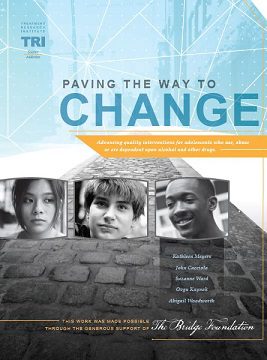
Paving the Way to Change: Advancing Quality Interventions for Adolescents Who Use, Abuse or Who are Dependent Upon Alcohol or Other Drugs, provides insight into the individual, societal and financial consequences of adolescent alcohol, drug use and other substance use disorders. It provides an overview of the current treatment system and an explanation of why it’s failing our kids. It provides a new opportunity and a clearer lens for viewing and ultimately treating adolescents, as well as how to approach financing the system.

Paving the Way to Change outlines the challenges that our field and our community must address to quell the tide of adolescent substance abuse in this country. The changes that are needed will not be simple. They will not be quick. They will require coordinated and effective advocacy efforts. But they will be worth it. I encourage you check out this report and share it with your friends and colleagues. The role of your advocacy is critical and it can drive needed change.

We, as advocates, have varied and powerful resources to bring to bear. We are researchers, families, legislators, people in recovery, clinicians, educators and friends. Together, we can create the change that is needed, and that will lead to important and sustained changes in the way care is delivered to adolescents and young adults who are at risk for, who have abused, and who are recovering from substance use.

Please tell us what you think. Please share this with your colleagues. Please prioritize collaboration. Together, we can shape the future of adolescent substance abuse prevention and treatment. Join our efforts.

Learn more about the Treatment Research Institute.

Kathleen Meyers, Ph.D. has more than 25 years of clinical research experience. She is a recognized leader in the assessment and treatment of adolescent substance use disorders (SUD), delinquency and co-morbidity and is the author of the Comprehensive Adolescent Severity Inventory (CASI), a multidimensional assessment instrument for youth with co-morbidity that is widely used throughout the United States, Canada and abroad. She has served on numerous expert panels sponsored by the Substance Abuse and Mental Health Services Administration (SAMHSA), the National Institute of Drug Abuse (NIDA), the National Institute of Justice (NIJ), and the Office of Juvenile Justice and Delinquency Prevention (OJJDP), as well as on peer review, institutional review and editorial review boards. Dr. Meyers has published extensively, including as first author of an invited chapter for the Adolescent Mental Health Initiative’s Treating and Preventing Adolescent Mental Health Disorders: What We Know and What We Don’t Know (named the best book in clinical medicine by the Association of American Publishers). She holds a Bachelor of Arts degree in Psychology & Statistics from Rutgers University, a Master of Science in Evaluation and Applied Research from Hahnemann University and a Doctorate degree in Educational Psychology from Temple University.


Privacy Being Tightened for Prescription Drug Monitoring Databases


The privacy of information contained in prescription drug monitoring databases is being tightened, The Wall Street Journal reports. Privacy advocates hail the trend, while law enforcement officials say it is hampering their attempts to curb prescription drug abuse.


Some courts and lawmakers are beginning to restrict access to the databases, citing a violation of privacy rights. A U.S. court in Oregon ruled in February that federal agents needed a warrant to search the state’s database. Rhode Island has made it more difficult for law enforcement to search its database. In Florida and Pennsylvania, lawmakers are considering measures that would limit access to its prescription drug data.


“The public and lawmakers are really starting to understand what kinds of threats to privacy come when we start centralizing great quantities of our sensitive personal information in giant electronic databases,” said Nathan Wessler, an attorney with the American Civil Liberties Union. The group represented patients and a doctor who challenged the Drug Enforcement Administration in the Oregon case.


Forty-eight states have prescription monitoring databases for drugs that have a high potential for abuse. Law enforcement officials in 17 states must have court approval before they search their state database. While Vermont does not allow law enforcement access to its database, other states generally make it fairly easy for investigators to access the data.


The number of law enforcement searches of Utah’s database increased from 2,288 in 2007, to more than 19,000 last year. Police must show they have a reasonable belief that a person has committed a crime in order to gain a search warrant.
myrecovery.com


Daily Quote
"When someone is suffering deeply within themselves, their suffering spills over and they start making others suffer as well. What they truly need is our help, not punishment." - Thich Nhat Hanh
Today's Online Meetings

AA Meeting - 8:00 pm CST: "Face to Face"

Guest Speaker - 1:00 pm CST: "Mike J and the Big Book"

Attend


Copyright 2011 Community of Recovering People LLC
Privacy Policy

Find us on Facebook


10 Percent of Older Teens Had Major Depressive Episode in Past Year: Report

A new government report finds 10 percent of 16- and 17-year-olds had a major depressive episode in the past year. Almost 20 percent of young adults, ages 18 to 25, had any mental illness in the past year.

Four percent of young adults had a serious mental illness, according to the report by the Substance Abuse and Mental Health Services Administration (SAMHSA). The report also found 3 percent of older teens had both a major depressive episode and a substance use disorder; 6.4 percent had any mental illness and a substance use disorder; and 1.6 percent had a serious mental illness and a substance use disorder.

Older teens and young adults with emotional and behavioral health problems are much more likely to have significant problems with school, employment and housing, the report found. Almost 8 percent of older teens who suffer from depression and have a substance use disorder do not have a stable place to live. They moved an average of three or more times in the past year. Among older teens with depression and a substance use disorder who were enrolled in school, 13.5 percent struggled academically, with a “D” or lower average.

Young adults with a serious mental illness and a substance use disorder are less likely to graduate high school, compared with those without both disorders. They are also 1.4 times more likely to be unemployed. Young adults with a serious mental illness who receive treatment are more likely to graduate high school than those who do not receive any treatment.

“This new report demonstrates the critical need for treatment and other services that focus on older adolescents and young adults with mental and substance use disorders,” SAMHSA Administrator Pamela S. Hyde said in a news release.

Less Than Half of College Students Say Misuse of Prescription Stimulants is “Cheating”

Only 41 percent of college students say misusing prescription stimulants for academic purposes should be considered cheating, according to a survey at an unnamed Ivy League institution. The survey found 18 percent of students said they misused stimulant drugs in an attempt to gain an academic advantage at least once in college.

Of students who used stimulant drugs, 24 percent said they had done so eight or more times, Inside Higher Ed reports. While 33 percent of students did not think using drugs such as Adderall or Ritalin was cheating, 25 percent were unsure, and 41 percent considered it cheating.

“While many colleges address alcohol and illicit drug abuse in their health and wellness campaigns, most have not addressed prescription stimulant misuse for academic purposes,” researcher Andrew Adesman of Steven and Alexandra Cohen Children’s Medical Center of New York, said in a news release. “Because many students are misusing prescription stimulants for academic, not recreational purposes, colleges must develop specific programs to address this issue.”

The study included 616 college students without attention deficit hyperactivity disorder who completed an anonymous online questionnaire. More students who played a varsity sport and were affiliated with a Greek house said they misused stimulants, compared with students affiliated with only one or neither.

The findings were presented at the Pediatric Academic Societies annual meeting.

Wednesday, May 7, 2014


MAY 7 v 24 v 25 v 26 v 27 TWELVE STEPPING WITH POWER IN THE PROVERB 
So listen to me, my sons,
and pay attention to my words.
Don’t let your hearts stray away toward her.
Don’t wander down her wayward path.
For she has been the ruin of many;
many men have been her victims.
Her house is the road to the grave.
Her bedroom is the den of death.

STEP 2 - Came to believe that a Power greater than ourselves could restore us to sanity.

The proverb is talking about an adulterous woman but when I read the verses all I can think is this describes addiction to a T .There is not much more , I can say , except there is hope and you don't have to die to get sober . The next person who reaches out to you to help accept it . God always sends us help but we are so busy doing for us that we miss his voice in every situation . God has a plan , and you dieing a premature death is not it .
Matthew 11 :29 - Take my yoke upon you, and learn of me; for I am meek and lowly in heart: and ye shall find rest unto your souls.
By :Joseph Dickerson